|
*
ISIS 301012 lowered apoB-100 to at or below the lower limit of normal
in 8 of 8 patients and to the limit of detectability in 4 of 8 patients
dosed at 400 mg/week
* ISIS 301012 lowered LDL-C 70%, with similar effects on other atherogenic
lipids
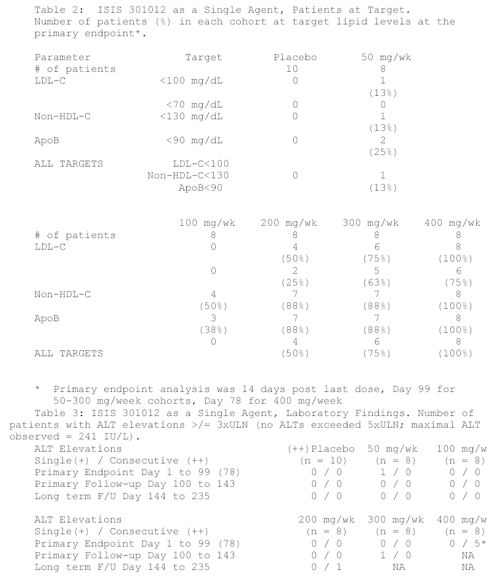
* 6 of 8 patients achieved LDL-C levels of less than 70 mg/dL; all 8 patients
achieved LDL-C levels below 100 mg/dL
* ISIS 301012 was well tolerated through 400 mg/week, a dose that produced
maximal measurable activity
NEW ORLEANS and CARLSBAD, Calif., March 25 /PRNewswire-FirstCall/ -- Isis
Pharmaceuticals, Inc. (Nasdaq: ISIS)
announced new results from its monotherapy Phase 2 clinical trial of ISIS
301012 presented at the American College of Cardiology Annual Scientific
Session (ACC) in New Orleans. In the dose cohort presented today, patients
with high cholesterol were treated for ten weeks with 400 mg/week of ISIS
301012. Data for dose cohorts through 300 mg/week in which patients were
treated for three months were previously reported. In this study, increasing
the dose of ISIS 301012 to 400 mg/week was well tolerated and further
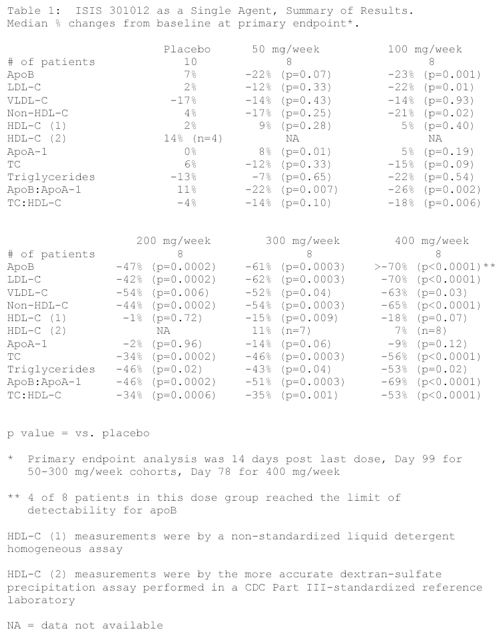
reduced atherogenic lipids, with median improvements in LDL-cholesterol
(LDL-C), non-HDL-cholesterol (non-HDL-C), total cholesterol (TC) and triglycerides
(TG) of 70%, 65%, 56% and 53%, respectively. Collectively, data from this
study demonstrate that the anticipated doses 100 - 300 mg/week should
have broad lipid-lowering activity and be well tolerated. Notably, by
ten weeks into the protocol-specified thirteen-week dosing period, all
eight treated patients in the cohort had levels of apoB-100 that were
at or below the lower limit of normal (<60 mg/dL), and four of the
eight had undetectable levels of apoB-100 (<35 mg/dL). Because further
activity was not measurable, dosing was discontinued and patients progressed
directly into follow-up. All eight patients were evaluable per protocol,
and the primary endpoint data presented in tabular form below was derived
from patients' visit 14 days after the last dose, or study day 78 for
this dose cohort. All patients in this dose cohort achieved LDL-C levels
below the recommended 100 mg/dL target for patients in the High Risk category
(see Adult Treatment Panel III Recommendations below). Six of eight, or
75% of patients achieved LDL-C levels below the optional lower target
of 70 mg/dL. Post dosing, LDL-C levels for patients in this dose cohort
ranged from 24 mg/dL to 97 mg/dL. There were no drug-related serious adverse
events in the study, and the most common drug-related adverse events were
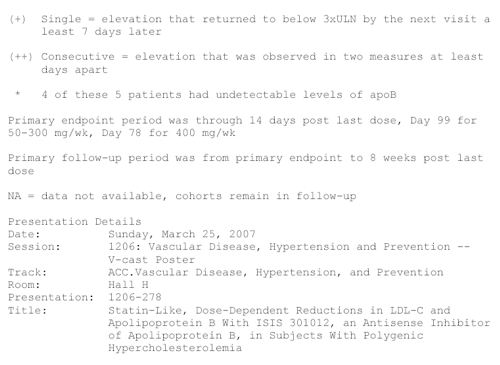
painless mild to moderate injection site reactions. Elevations in liver
transaminases (ALT) were observed in this high-dose cohort; five of the
eight patients dosed at 400 mg/week, including all four patients with
undetectable levels of apoB, experienced modest ALT elevations at or above
three times the upper limit of normal (3xULN). No patients experienced
ALT elevations greater than 5xULN; the maximal ALT observed was 241 IU/L.
Importantly, no patients evidenced liver chemistries that would suggest
risk of liver injury (extremely high ALT or ALT elevations together with
elevations in bilirubin greater than 2xULN). The mild increases in ALT
at the 400 mg/week dose likely reflect extreme lipid-lowering activity,
not toxicity, and are consistent with perturbations in liver chemistries
seen with statins. As predicted from animal studies with this drug and
cumulative experience with other second-generation antisense drugs, there
were no effects on kidney function. Patients in this dose cohort remain
in follow-up. According to Evan Stein, M.D., Ph.D., Director, Metabolic
and Atherosclerosis Research Center, Cincinnati, Ohio, lead investigator
in the study, "The clinical evidence supporting the activity and tolerability
of ISIS 301012 has accumulated to a point at which it seems clear that
ISIS 301012 is likely to play an important role in the management of high
cholesterol. The drug's pronounced activity, its predictability, its reduction
of all atherogenic lipids and triglycerides, as well as the opportunity
for assured patient compliance with infrequent subcutaneous dosing are
all attractive attributes. ISIS 301012 has broad potential in a variety
of hyperlipidemic populations, and I'm looking forward to participating
in its further development." Henry Ginsberg, M.D., Professor of Medicine
at Columbia University in New York commented, "These new results are important
because the outstanding results at 400 mg/week with good tolerability
indicate that the 200 and 300 mg/week doses should have excellent safety
profiles along with the outstanding therapeutic activity." Mark Wedel,
M.D., J.D., Isis' Chief Medical Officer, added, "We have been able to
define the full dose-response range of a drug through 400 mg/week, although
with the potent and broad lipid-lowering activity we have seen at 200
and 300 mg/week, we do not expect to need to advance the 400 mg/week dose
in registration studies. We continue to be encouraged by the performance
of ISIS 301012, and look forward to initiating a longer-term Phase 2 study
in patients with routine high cholesterol in combination with statins
in which we will define induction and maintenance doses. We expect induction
doses to be 200 to 300 mg/week and maintenance doses to be 100 to 200
mg/week. In addition, later this year we will begin our registration program
for familial hypercholesterolemia." Jeff Jonas, M.D., Executive Vice President,
Isis Pharmaceuticals, said, "In less than 10 weeks with 400 mg/week of
ISIS 301012, we were able to reduce apoB to undetectable levels in many
of these patients. These levels are similar to those seen in patients
with familial hypobetalipoproteinemia (FHBL), a genetic disorder that
causes very low apoB levels. To have rapidly achieved these levels with
only modest elevations in ALT and no evidence of liver dysfunction is
remarkable and further confirms the exciting potential of the lower-dose
induction and maintenance regimens we plan." ISIS 301012 as a Single Agent
This randomized, double-blinded, placebo-controlled, dose-escalation trial
treated patients with high cholesterol (baseline median LDL-C ranging
from 154 - 206 mg/dL) for three months with ISIS 301012 as a single agent.
In April 2006, results for the first three dose cohorts through 200 mg/week
were presented, and in November 2006, results for the 300 mg/week cohort
were presented. In today's poster, the data from the 400 mg/week dose
cohort were presented, with median reductions of 70% in LDL-C, 65% in
non-HDL-C, 56% in TC and 53% in TG. These data demonstrate that in contrast
to statins, ISIS 301012 causes linearly increasing reductions of atherogenic
lipids as doses are increased. At doses which decreased LDL-C and apoB
more than 50%, there were modest reductions in HDL-cholesterol (HDL-C)
when measured via the protocol-specified liquid detergent homogenous assay
that was non- standardized; these results were contradicted when samples
were re-evaluated in a blinded manner by a CDC Part III-standardized reference
laboratory performing the more accurate dextran-sulfate precipitation
assay. The ratios of apoB to apoA-1 (the protein components of LDL-C and
HDL-C particles, respectively) and TC to HDL-C, which are indicators of
cardiovascular risk, showed dose-dependent favorable decreases throughout
the dose range.
More
about Phase 2 Trials for ISIS 301012 Additional data from two studies
in which ISIS 301012 is being dosed in combination with statins and other
lipid-lowering therapies are being presented at the ACC. Tomorrow morning,
results of an ongoing trial of ISIS 301012 added to maximal lipid-lowering
therapies in homozygous familial hypercholesterolemia (FH) patients will
be presented, and tomorrow afternoon results of a trial adding ISIS 301012
for five weeks at 400 mg/week in patients with routine high cholesterol
on stable statin therapy will be reported, both in oral sessions. Extended
three-month treatment periods are planned for subsequent cohorts of 200
and 300 mg/week doses in the statin coadministration study, to be reported
later in the year. Also later in the year, results from an ongoing double-blind,
placebo-controlled, dose- escalation study in patients with heterozygous
FH will be reported. ISIS 301012 has been granted orphan drug status for
the treatment of homozygous FH and Isis plans to begin registration-directed
studies for FH in 2007. About ISIS 301012 and Cholesterol ISIS 301012
is a second-generation antisense drug that reduces the production of apoB-100,
a protein critical to the synthesis and transport of "bad" cholesterol
and a target that has proved to be undruggable using traditional, small-molecule
approaches. Cholesterol can be carried in the bloodstream in a variety
of forms, with high-density lipoprotein, or HDL-C, being the good form,
and low-density lipoproteins, or LDL-C, and very low- density lipoproteins,
or VLDL-C, being bad forms directly involved in heart disease. Collectively,
LDL-C, VLDL-C, and other bad forms of cholesterol are referred to as "non-HDL-C."
The lowering of non-HDL-C is a key component in the prevention and management
of cardiovascular disease. Isis plans to develop ISIS 301012 as the drug
of choice for patients who are unable to achieve target cholesterol levels
with statins alone or who are intolerant of statins. Adult Treatment Panel
III Recommendations The National Cholesterol Education Program's Adult
Treatment Panel III guidelines for target LDL-C levels High-Risk patients
is less than 100 mg/dL, with an optional target of less than 70 mg/dL.
For Moderately High-Risk patients, the target is less than 130 mg/dL.
Over 20 million people in the U.S. in the High-Risk and Moderately High-Risk
categories are failing to meet recommended LDL-C targets using currently
available lipid-lowering therapies. ABOUT ISIS PHARMACEUTICALS, INC. Isis
is exploiting its expertise in RNA to discover and develop novel drugs
for its product pipeline and for its partners. The Company has successfully
commercialized the world's first antisense drug and has 17 drugs in development.
Isis' drug development programs are focused on treating cardiovascular
and metabolic diseases. Isis' partners are developing drugs for cancer,
and inflammatory and other diseases. Ibis Biosciences, Inc., Isis' wholly
owned subsidiary, is developing and commercializing the Ibis T5000 Biosensor
System, a revolutionary system to identify infectious organisms. As an
innovator in RNA-based drug discovery and development, Isis is the owner
or exclusive licensee of over 1,500 issued patents worldwide. Additional
information about Isis is available at http://www.isispharm.com/.
This press release includes forward-looking statements regarding the development,
activity, therapeutic potential and safety of ISIS 301012 in treating
high cholesterol. Any statement describing Isis' goals, expectations,
financial or other projections, intentions or beliefs is a forward-looking
statement and should be considered an at-risk statement, including those
statements that are described as Isis' goals or projections. Such statements
are subject to certain risks and uncertainties, particularly those inherent
in the process of discovering, developing and commercializing drugs that
are safe and effective for use as human therapeutics, in developing and
commercializing systems to identify infectious organisms that are effective
and commercially attractive, and in the endeavor of building a business
around such products. Isis' forward-looking statements also involve assumptions
that, if they never materialize or prove correct, could cause its results
to differ materially from those expressed or implied by such forward-
looking statements. Although Isis' forward-looking statements reflect
the good faith judgment of its management, these statements are based
only on facts and factors currently known by Isis. As a result, you are
cautioned not to rely on these forward-looking statements. These and other
risks concerning Isis' programs are described in additional detail in
Isis' annual report on Form 10-K for the year ended December 31, 2006,
which is on file with the SEC. Copies of this and other documents are
available from the Company.
SOURCE Isis Pharmaceuticals, Inc.
|
