| Abstract |
CONTEXT:
Aspirin therapy reduces the risk of cardiovascular disease in adults who
are at increased risk. However, it is unclear if women derive the same
benefit as men.
OBJECTIVE: To determine if the benefits and risks of aspirin treatment
in the primary prevention of cardiovascular disease vary by sex.
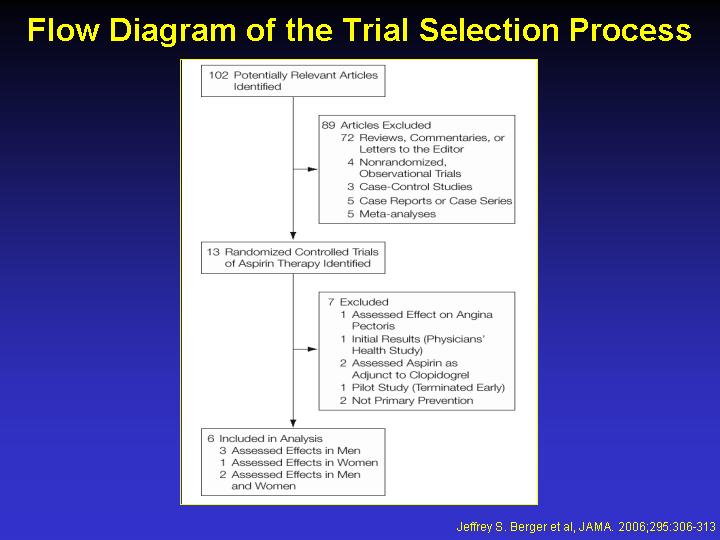
DATA SOURCES AND STUDY SELECTION: MEDLINE and the Cochrane Central Register
of Controlled Trials databases (1966 to March 2005), bibliographies of
retrieved trials, and reports presented at major scientific meetings.
Eligible studies were prospective, randomized controlled trials of aspirin
therapy in participants without cardiovascular disease that reported data
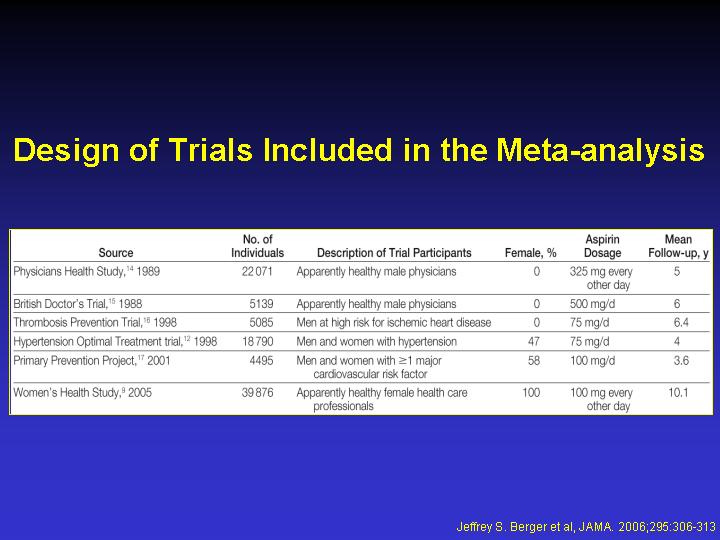
on myocardial infarction (MI), stroke, and cardiovascular mortality. Six
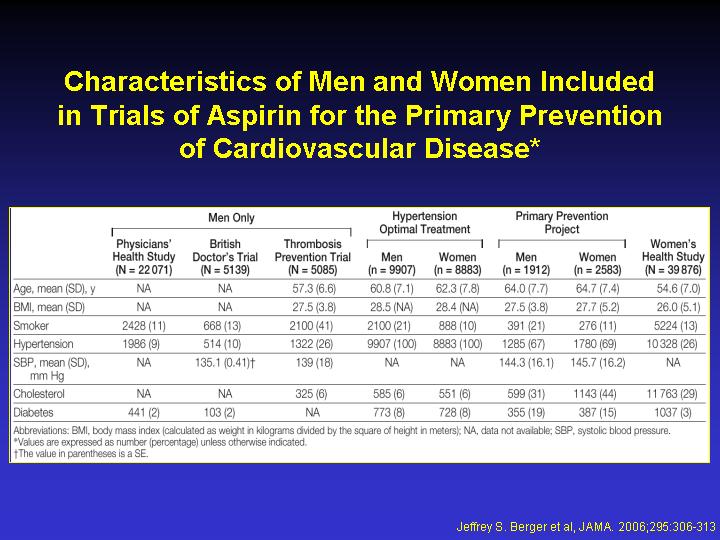
trials with a total of 95 456 individuals were identified; 3 trials included
only men, 1 included only women, and 2 included both sexes.
DATA EXTRACTION: Studies were reviewed to determine the number of patients
randomized, mean duration of follow-up, and end points (a composite of
cardiovascular events [nonfatal MI, nonfatal stroke, and cardiovascular
mortality], each of these individual components separately, and major
bleeding).
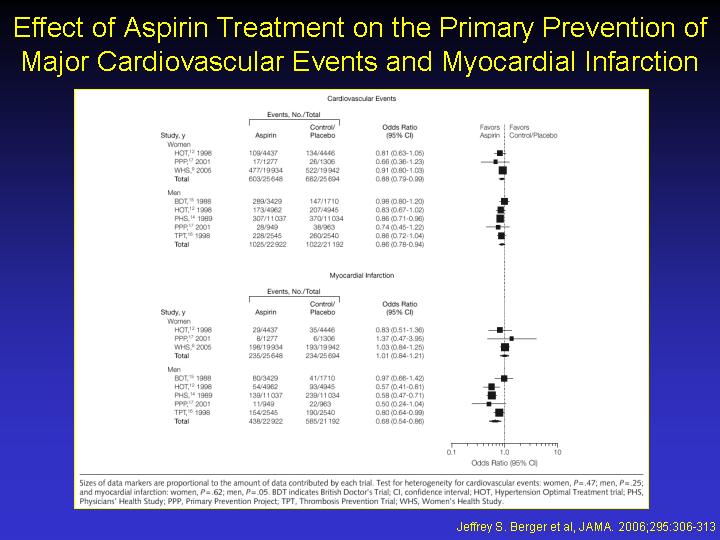
DATA SYNTHESIS: Among 51,342 women, there were 1285 major cardiovascular
events: 625 strokes, 469 MIs, and 364 cardiovascular deaths. Aspirin therapy
was associated with a significant 12% reduction in cardiovascular events
(odds ratio [OR], 0.88; 95% confidence interval [CI], 0.79-0.99; P = .03)
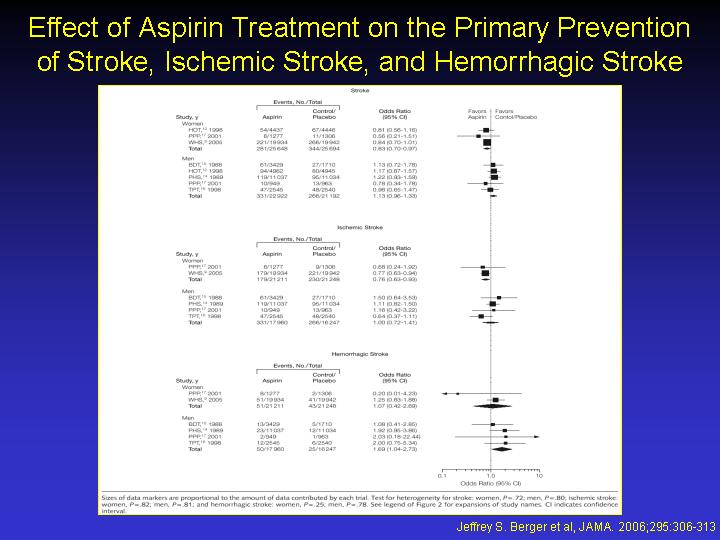
and a 17% reduction in stroke (OR, 0.83; 95% CI, 0.70-0.97; P = .02),
which was a reflection of reduced rates of ischemic stroke (OR, 0.76;
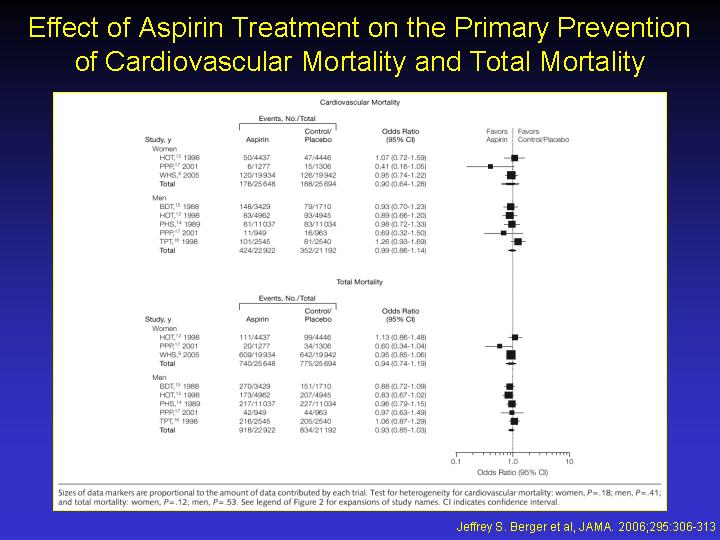
95% CI, 0.63-0.93; P = .008). There was no significant effect on MI or
cardiovascular mortality. Among 44,114 men, there were 2047 major cardiovascular
events: 597 strokes, 1023 MIs, and 776 cardiovascular deaths. Aspirin
therapy was associated with a significant 14% reduction in cardiovascular
events (OR, 0.86; 95% CI, 0.78-0.94; P = .01) and a 32% reduction in MI
(OR, 0.68; 95% CI, 0.54-0.86; P = .001). There was no significant effect
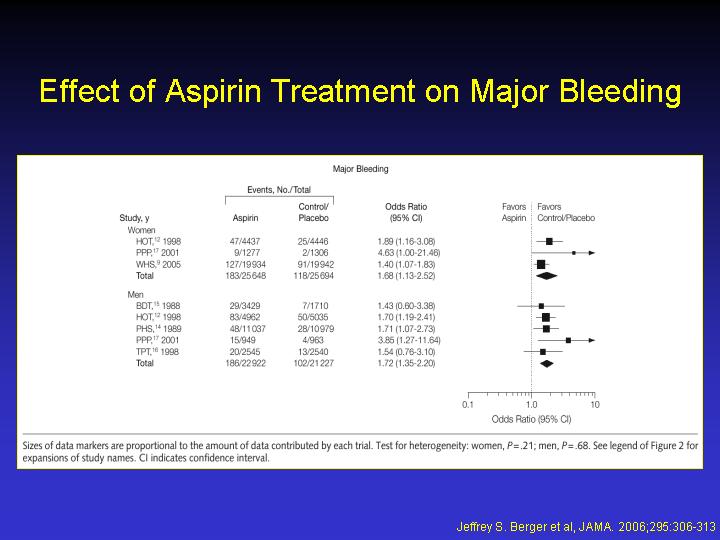
on stroke or cardiovascular mortality. Aspirin treatment increased the
risk of bleeding in women (OR, 1.68; 95% CI, 1.13-2.52; P = .01) and in
men (OR, 1.72; 95% CI, 1.35-2.20; P<.001).
CONCLUSIONS: For women and men, aspirin therapy reduced the risk of a
composite of cardiovascular events due to its effect on reducing the risk
of ischemic stroke in women and MI in men. Aspirin significantly increased
the risk of bleeding to a similar degree among women and men.
|