| Text |
Percutaneous
coronary intervention was first accepted as a valuable treatment for coronary-artery
disease in the 1980s, and became widely used after the introduction of
stents reduced the rate of restenosis. However, acute ischaemic complications
triggered by abrupt vessel closure have always been an associated risk.
In previous years, anticoagulants were deemed essential for weeks after
percutaneous coronary intervention; heparin doses would be cautiously
tapered a few hours after the procedure to allow sheath removal and then
treatment with warfarin would be started. However, platelet inhibition,
rather than coagulation, was shown to be the key to prevention of acute
and subacute thrombosis after percutaneous coronary intervention,1 and
the use of double-antiplatelet therapy, as a simpler, safer, and more
effective way to avoid stent-related ischaemic events, became routine.
Treatment with aspirin and ticlopidine for a month after stenting has
long been an effective and safe mainstay. Most patients who undergo elective
percutaneous coronary intervention are now discharged after 24—48
h, and hardly any have acute ischaemic complications. Clopidogrel—another
thienopyridine—has progressively replaced ticlopidine, mainly because
it acts rapidly when given as an oral bolus. This quality means it can
be given in a catheterisation laboratory after coronary angiography, when
the decision is made to do percutaneous coronary intervention.2
However, haemorrhagic complications still affect, in particular, older
and female patients, patients with renal impairment or diabetes, and those
receiving double-antiplatelet therapy for many months after the placement
of a drug-eluting stent. Even minor bleeding affects prognosis after percutaneous
coronary intervention,3—6 and recent data suggest that more deaths
after an acute-coronary syndrome are caused by bleeding than by reinfarction
or stent thrombosis.7 Any new antithrombotic approach capable of reducing
bleeding complications while retaining an equivalent anti-ischaemic profile
would therefore be welcome.
Thrombin is the main mediator of blood coagulation, first in the initial
activation of platelets and zymogens (factors VII, V, VIII, IX, and X),
and then in the amplification and cleavage of fibrinogen to fibrin. Thrombin-activated
platelets are essential for assembling activated coagulation factors into
complexes, which then begin to cleave inactive zymogens and lead to the
explosive phase of the cascade. Thrombin is the most potent platelet activator
and is not influenced by thienopyridine or aspirin. Selective blocking
of the thrombin receptor effectively inhibits thrombin-dependent platelet
activation (the pathway involved in thrombosis) without affecting collagen-dependent
activation (the pathway involved in haemostasis). Furthermore, this blockade
does not affect thrombin's proteolytic action or its effect on coagulation
factors.8
In The Lancet today, Richard Becker and colleagues9 report on a thrombin-receptor-1
antagonist in a phase II, placebo-controlled study of SCH 530348. The
drug was given orally at least 1 h before percutaneous coronary intervention
in three randomised loading doses, and then continued in three further
randomised dose-groups for 2 months. All patients received aspirin and
a loading dose of clopidogrel before percutaneous coronary intervention,
and took both drugs for 4 weeks.
The findings suggest that SCH 530348 is safe, a conclusion strengthened
by it being used with two other antiplatelet agents. Major and minor TIMI
bleeding event rates were similar to those in PCI-CURE10 and CREDO11 (table).
Patients given the highest loading dose had a more than 80% reduction
in thrombin-receptor-agonist peptide-mediated aggregation 90 min after
bolus administration, and all of the drug regimens were highly effective
in blocking the thrombin-mediated aggregation pathway during follow-up.
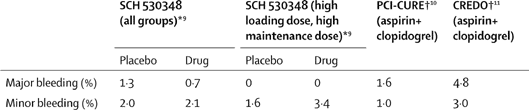 |
Comparative
bleeding incidence in percutaneous coronary interevention
This clinical report of a new antithrombotic drug developed on the basis
of new knowledge about the coagulation cascade suggests that the drug
works. Is the dream of an effective antithrombotic drug with a low bleeding
risk becoming reality? Will this approach be effective in the acute setting
(eg, primary percutaneous coronary intervention) and even in secondary
prevention? Phase III trials will determine whether we are entering a
new antithrombotic era.
AC declares that he has no conflict of interest. PM is national lead investigator
for the TRA-2P study in Italy, and collaborates with the TIMI group.
References
1 Schömig A, Neumann FJ, Kastrati A, et al. A randomized comparison
of antiplatelet and anticoagulant therapy after the placement of coronary-artery
stents. N Engl J Med 1996; 334: 1084-1089.
2 Widimsky P, Motovská Z, Simek S, et al. Clopidogrel pre-treatment
in stable angina: for all patients >6 h before elective coronary angiography
or only for angiographically selected patients a few minutes before PCI?
A randomized multicentre trial PRAGUE-8. Eur Heart J 2008; 29: 1495-1503.
3 Moscucci M, Fox KA, Cannon CP, et al. Predictors of major bleeding in
acute coronary syndromes: the global registry of acute coronary events
(GRACE). Eur Heart J 2003; 24: 1815-1823.
4 Rao SV, Jollis JG, Harrington RA, et al. The relationship of blood transfusion
and clinical outcome in patients with acute coronary syndromes. JAMA 2004;
292: 1555-1562.
5 Rao SV, O'Grady K, Pieper KS, et al. Impact of bleeding severity on
clinical outcomes among patients with acute coronary syndromes. Am J Cardiol
2005; 96: 1200-1206.
6 Eikelboom JW, Mehta SR, Anand SS, et al. Adverse impact of bleeding
on prognosis in patients with acute coronary syndromes. Circulation 2006;
114: 774-782.
7 Stone GW, Witzenbichler B, Guagliumi G, et alfor the HORIZONS-AMI Trial.
Bivalirudin during primary PCI in acute myocardial infarction. N Engl
J Med 2008; 358: 2218-2230.
8 Chintala M, Shimizu K, Ogawa M, Yamaguchi H, Doi M, Jensen P. Basic
and translational research on proteinase-activated receptors: antagonism
of the proteinase-activated receptor 1 for thrombin, a novel approach
to antiplatelet therapy for atherothrombotic disease. J Pharmacol Sci
2008; 108: 433-448.
9 Becker RC, Moliterno DJ, Jennings LK, et alfor the TRA-PCI. Safety and
tolerability of SCH 530348 in patients undergoing non-urgent percutaneous
coronary intervention: a randomised, double-blind, placebo-controlled
phase II study. Lancet 2009; 373: 919-928.
10 Mehta SR, Yusuf S, Peters RJ, et alfor the Clopidogrel in Unstable
angina to prevent Recurrent Events trial (CURE). Effects of pretreatment
with clopidogrel and aspirin followed by long-term therapy in patients
undergoing percutaneous coronary intervention: the PCI-CURE study. Lancet
2001; 358: 527-533.
11 Steinhubl SR, Berger PB, Mann JT, et alfor the Clopidogrel for the
Reduction of Events During Observation (CREDO). Early and sustained dual
oral antiplatelet therapy following percutaneous coronary intervention:
a randomized controlled trial. JAMA 2002; 288: 2411-2420.
|
