| Text |
Three
large trials of rosuvastatin to prevent cardiovascular events have been
completed.1—3 Two of these, CORONA and GISSI-HF,1, 2 assessed 10
mg rosuvastatin daily. Substantial reductions in LDL cholesterol, a small
increase in HDL cholesterol, and appreciable reductions in high-sensitivity
C-reactive protein (hs-CRP) were reported. CORONA enrolled patients with
ischaemic heart disease, whereas GISSI-HF included patients with ischaemic
(40%), dilated (35%), and hypertensive (18%) causes of heart failure.
Because such patients are probably at risk for future ischaemic vascular
events, lowering of LDL cholesterol would be expected to reduce cardiovascular
death, myocardial infarction, and stroke. Yet in neither trial was there
a clear reduction in ischaemic vascular events or cardiovascular mortality.
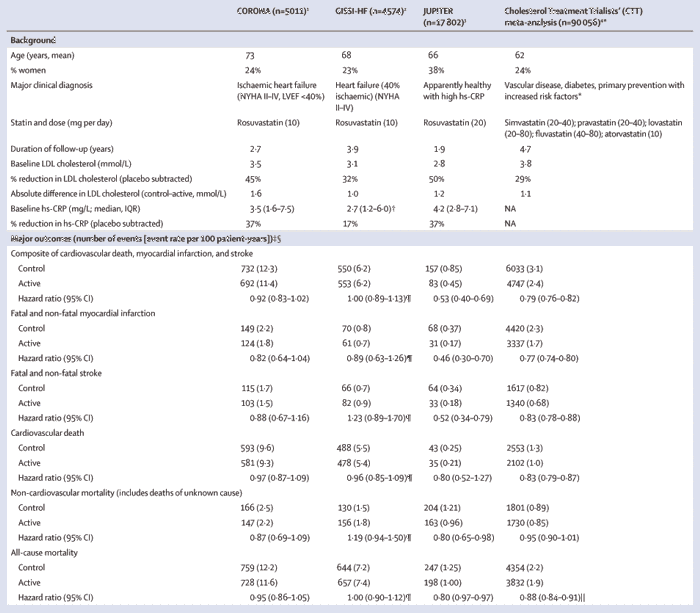
Major
trials of rosuvastatin in context of other major statin trials
By
contrast, in the JUPITER trial,3 17 802 apparently healthy people, with
LDL cholesterol less than 3·4 mmol/L and CRP concentrations above
2·0 mg/L, received rosuvastatin 20 mg daily. LDL cholesterol decreased
by 50% and CRP by 37%. Over 1·9 years, there were substantial and
significant reductions in ischaemic vascular events as well as total mortality,
which were larger and more rapid than those in previous trials of rosuvastatin
or other statins.4
How can we explain the apparently contradictory results of JUPITER compared
with CORONA and GISSI-HF? In all three trials, CRP was raised, and substantial
reductions in both LDL cholesterol and CRP occurred. The duration of the
first two trials was much longer than that of JUPITER, and because the
benefits of lipid lowering are enhanced by longer follow-up, the larger
and more rapid benefit in JUPITER compared with previous statin trials
is a surprise. For example, a 1 mmol/L lowering in LDL cholesterol reduces
the risk of vascular events by 10% after 1 year, 25% after 2—3 years,
and about 30% after 4 years.4 The 50% risk reduction in vascular events
in JUPITER, after a 1·2 mmol/L drop in LDL cholesterol after 1·9
years, is unexpectedly large and rapid.
Although JUPITER explicitly chose healthy people with raised CRP, most
people in CORONA and GISSI-HF were likely to also have raised CRP. Moreover,
in all three trials, rosuvastatin lowered CRP; yet in CORONA and GISSI-HF
little overall benefit was observed. A subgroup analysis from CORONA showed
little benefit of rosuvastatin in those with high concentrations of CRP.
But a re-analysis5 suggested a 13% relative risk reduction in those with
a CRP concentration of 2·0 mg/L or more, compared with no benefit
in those with CRP less than 2·0 mg/L. While subgroup results are
intriguing, they suggest a far more modest effect than that observed in
JUPITER and, being retrospective, require independent confirmation.
While advanced myocardial disease in individuals in the heart failure
trials might explain a lack of effect of rosuvastatin on mortality, specific
ischaemic events, such myocardial infarction or stroke, would be expected
to be reduced. In CORONA, there were fewer myocardial infarctions and
strokes (table), but the benefit was modest and not significant. In GISSI-HF,
the reduction of fatal and non-fatal myocardial infarction was also modest
and there was no reduction in strokes (table). The benefit of rosuvastatin
for specific ischaemic events in the two trials seems to be less than
what could be expected on the basis of secondary prevention trials, whereas
the large effect in JUPITER was greater than that expected.6
The table compares rosuvastatin trials with a meta-analysis of previous
primary and secondary prevention trials. This meta-analysis indicates
that for about a 1 mmol/L reduction in LDL over 5 years, there is a 21%
risk reduction in vascular events, and a 12% risk reduction in mortality.
These estimates are similar in primary6 and secondary prevention trials,4
and are more modest than that in JUPITER. Furthermore, a recent trial
of simvastatin and ezetemibe in mild-to-moderate aortic stenosis7 showed
that a 50% reduction in LDL over 4·4 years led to a 17% decrease
in vascular events and no reduction in mortality. Additionally, there
was a reduction in non-cardiovascular deaths of about 20% in JUPITER (chiefly
due to fewer cancer deaths) that was as large as the reduction in cardiovascular
deaths. This finding is not biologically plausible (2 years is too short
to influence cancer) and inconsistent with previous trials. Therefore,
chance might have exaggerated the apparent benefits in JUPITER (compounded
by the trial's early termination). In view of the results of all other
statin trials, the real benefits of lowering LDL by 1·2 mmol/L
for about 2 years (as in JUPITER) is unlikely to be larger than a 20—30%
reduction in relative risk for ischaemic events, and a 10% reduction for
total mortality. Both estimates are within the 95% CI of the estimates
on specific events observed in JUPITER.
What are the clinical implications of the recent trials? First, rosuvastatin
seems safe in the medium term. Whether the excess in diabetes observed
in JUPITER is a chance finding or real is unclear, because it has not
been observed in other trials of statins. Indeed one trial with pravastatin
reported lower rates of diabetes,8 but it would be prudent to systematically
explore this point in all trials. Second, one would expect benefits from
rosuvastatin to be proportionate to the degree of lowering of LDL cholesterol
and the duration of treatment, so the best estimate on specific ischaemic
events might be the weighted average of all trials of rosuvastatin, when
viewed in the context of all other previous statin trials.4, 6 Third,
because the role of CRP as a predictor of risk remains controversial,9
its role as a marker of preferential benefits from statins should be evaluated
in ongoing trials, and in a meta-analysis of all trials that have stored
blood samples suitable for CRP measurement. Fourth, because in those without
clinical cardiovascular disease the absolute benefits are likely to be
modest in the short term (the absolute risk of events in JUPITER was low,
despite use of CRP as a marker of risk), much longer-term trials than
those currently completed are needed to discover the full benefits (which
may increase over time) and safety of life-long use. Fifth, the effect
of statins in several ethnic groups, such as Chinese people and south
Asians, needs clarification. In view of the potentially large public-health
and economic implications of widespread use of statins in apparently healthy
individuals with average risk levels, confirmation of the long-term results
of major lowering of LDL cholesterol (as can be safely achieved by rosuvastatin)
is needed before potent statins are used widely in average-risk healthy
people.
Substantial risk reductions in cardiovascular disease are theoretically
possible by combined lowering of blood pressure and LDL cholesterol in
those with average levels of both risk factors and no apparent vascular
disease, but this promising hypothesis needs assessment.10, 11 Whether
biomarkers such as CRP or N-terminal probrain natriuretic peptide7, 12
will be better than simple clinical risk factors in identifying individuals
who would benefit from preventive strategies remains unclear. At present,
tobacco avoidance, maintenance of optimum weight, a prudent diet, and
regular exercise should remain the foundations for prevention of cardiovascular
disease in apparently healthy individuals with average risk factors.
We thank Paul Ridker, Aldo Maggioni, John McMurray, and Colin Baigent
for providing additional unpublished analyses from the JUPITER and the
GISSI-HF trials, and from the Cholesterol Treatment Trialists' Collaboration;
and Ann Raback for secretarial assistance. We are all investigators in
the ongoing HOPE-3 trial that is evaluating combined lowering of blood
pressure and lipids (with rosuvastatin) in primary prevention. This investigator-initiated
trial is funded by the Canadian Institutes of Health Research through
a peer-reviewed grant, and by AstraZeneca who manufacture rosuvastatin.
SY has received research grants and honoraria from several companies that
manufacture statins (AstraZeneca, Bristol Myers Squibb, and Merck), EL
has received research grants and honoraria from several manufacturers
of statins (AstraZeneca, Merck, Pfizer), and JB has received grants from
AstraZeneca.
References
1 Kjekshus J, Apatrei E, Barrios V, et alfor the CORONA group. Rosuvastatin
in older patients with systolic heart failure. N Engl J Med 2007; 357:
2248-2261.
2 GISSI-HF Investigators. Effect of rosuvastatin in patients with chronic
heart failure (the GISSI-HF trial): a randomised, double-blind, placebo-controlled
trial. Lancet 2008; 372: 1231-1239.
3 Ridker PM, Danielson E, Fonseca FAH, et alfor the JUPITER Study Group.
Rosuvastatin to prevent vascular events in men and women with elevated
C-reactive protein. N Engl J Med 2008; 359: 2195-2207.
4 Cholesterol Treatment Trialists' (CTT) Collaboration. Efficacy and safety
of cholesterol-lowering treatment: prospective meta-analysis of data from
90 056 participants in 14 randomised trials of statins. Lancet 2005; 366:
1267-1278.
5 McMurray J, Kjekshus J, Hjialmarson A, Wedel H, Dunselman P, Wongstein
F. LDL independent reduction in cardiovascular morbidity and mortality
with rosuvastatin in heart failure patients with a raised C-reactive protein:
a retrospective analysis of the Controlled Rosuvastatin Multinational
Trial in heart failure (CORONA). Circulation 2008; 118 (suppl 2): S711.
6 Mills EJ, Rachlis B, Wu P, Devereaux PJ, Arora P, Perri D. Primary prevention
of cardiovascular mortality and events with statin treatments: a network
meta-analysis involving more than 65,000 patients. J Am Coll Cardiol 2008;
52: 1769-1781.
7 Rossebø AB, Pedersen TR, Boman K, et alfor the SEAS Investigators.
Intensive lipid lowering with simvastatin and ezetimibe in aortic stenosis.
N Engl J Med 2008; 359: 1343-1356.
8 Freeman DJ, Norrie J, Sattar N, et al. Pravastatin and the development
of diabetes mellitus: evidence for a protective treatment effect in the
West of Scotland Coronary Prevention Study. Circulation 2001; 103: 357-362.
9 Lloyd-Jones DM, Liu K, Tian L, Greenland P. Narrative review: assessment
of C-reactive protein in risk prediction for cardiovascular disease. Ann
Intern Med 2006; 145: 35-42.
10 Wald NJ, Law MR. A strategy to reduce cardiovascular disease by more
than 80%. BMJ 2003; 326: 1419.
11 Xavier D, Pais P, Sigamani A, Pogue J, Afzal R, Yusuf Son behalf of
The Indian Polycap Study (TIPS) Investigators. The need to test the theories
behind the Polypill: rationale behind the Indian Polycap Study. Nature
Clin Pract Cardiovasc Med 2009; 6: 96-97.
12 McKie PM, Rodeheffer RJ, Cataliotti A, et al. Amino-terminal pro-B
type natriuretic peptide and B type natriuretic peptide: biomarkers for
mortality in a large community-based cohort free of heart failure. Hypertension
2006; 47: 874-880.
|
