| Authors |
Parish
S, Peto R, Palmer A, Clarke R, Lewington S, Offer A, Whitlock G, Clark
S, Youngman L, Sleight P, Collins R; for the International Studies of
Infarct Survival (ISIS) collaborators.
|
| Abstract
|
AIMS
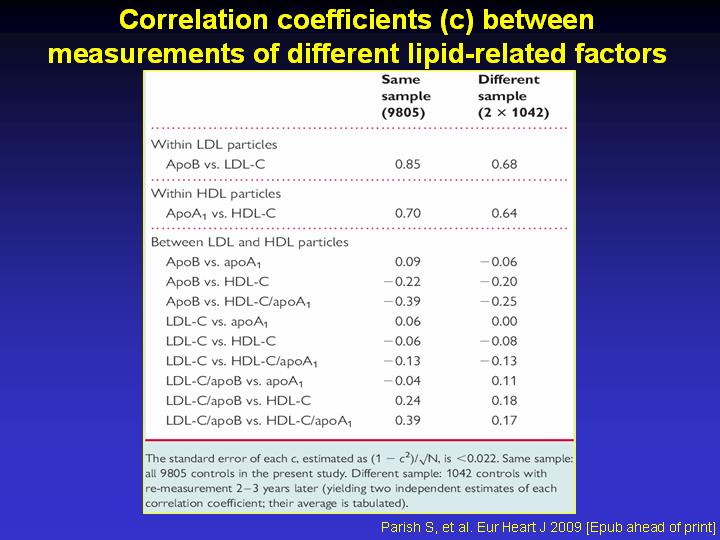
Plasma levels of apolipoprotein B (apoB), the main surface protein on
LDL particles, and LDL-C, the amount of cholesterol in those particles,
are closely correlated and, considered separately, are positive risk factors.
Plasma levels of apolipoprotein A1, the main surface protein on HDL particles,
and HDL-C, the amount of cholesterol in those particles, are also closely
correlated with each other and, considered separately, are negative risk
factors. The interdependence of these four risk factors is unclear.
METHODS AND RESULTS Case-control study among 3510 acute myocardial infarction
patients (without prior vascular disease, diabetes, or statin use) in
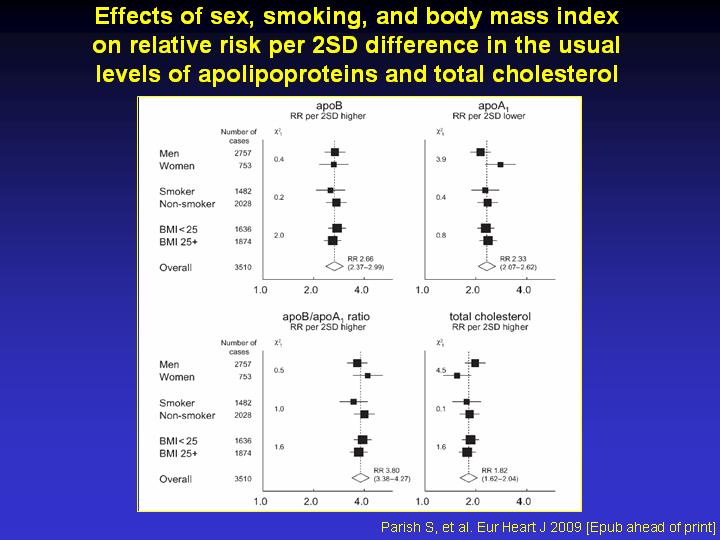
UK hospitals and 9805 controls. Relative risks (age, sex, smoking, and
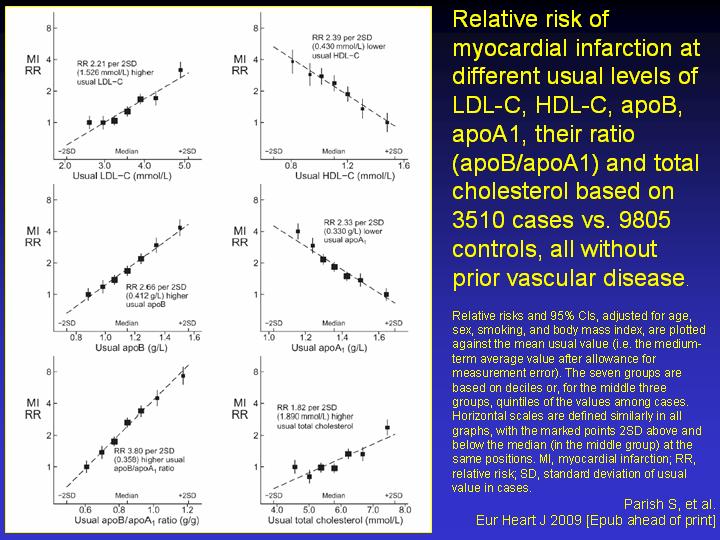
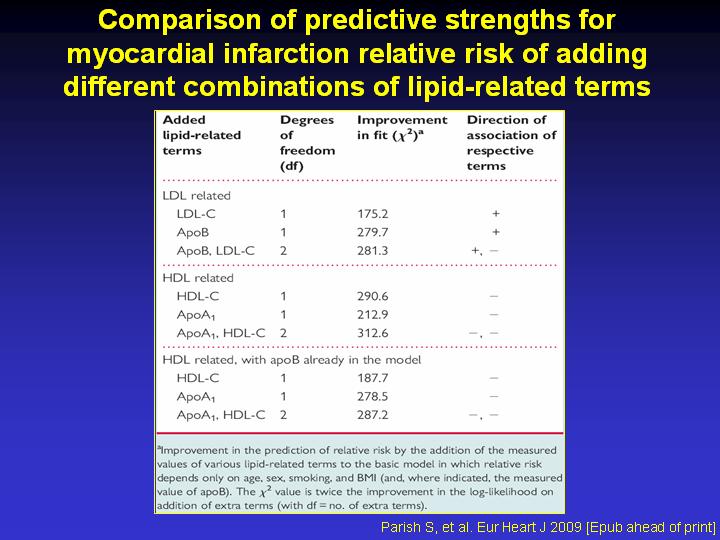
obesity-adjusted) were more strongly related to apoB than to LDL-C and,
given apoB, more strongly negatively related to apoA1 than to HDL-C. The
ratio apoB/apoA1 was uncorrelated with time since symptom onset in cases,
was reproducible in samples collected a few years apart in controls (correlation
0.81), and encapsulated almost all the predictive power of these four
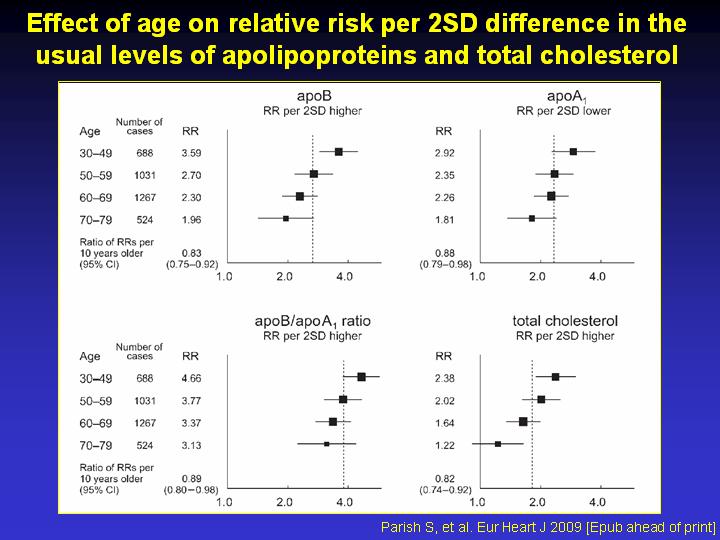
measurements. Its effect was continuous, substantial throughout the UK
normal range [relative risk, top vs. bottom decile of this ratio, 7.3
(95% CI 5.8-9.2)] and varied little with age. The ratio apoB/apoA1 was
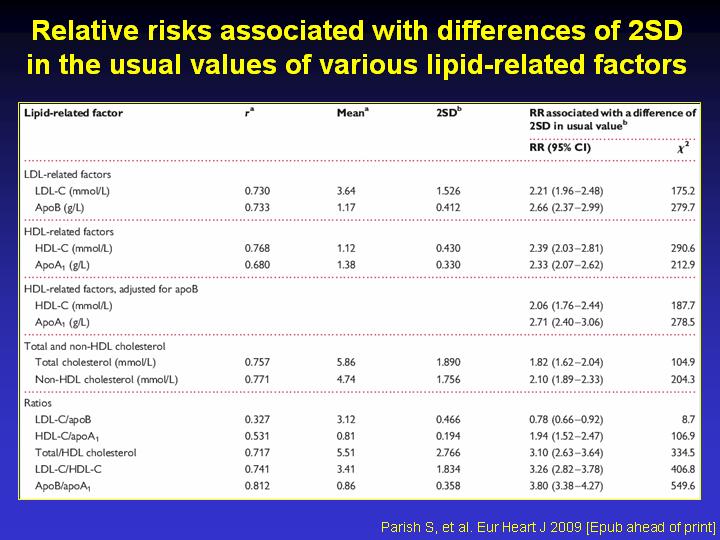
substantially more informative about risk ( x1 2 ¼ 550) than were
commonly used measures such as LDL-C/HDL-C, total/HDL cholesterol, non-HDL
cholesterol, and total cholesterol ( x1 2 ¼ 407, 334, 204, and
105, respectively). Given apoB and apoA1, the relationship with risk of
LDL-C was reversed, and this reversal was strengthened by appropriate
allowance for random measurement errors in two correlated variables. Given
usual apoB, lower LDL-C (consistent with smaller LDL particles) was associated
with higher risk (P , 0.0001). During the first 8 h after symptom onset
HDL-C increased by about 10%, precluding reliable assessment of the joint
relationship of apoA1 and pre-onset HDL-C with risk in such retrospective
case- control studies.
CONCLUSION Apolipoprotein ratios are more informative about risk than
lipid fractions are. This suggests that, among lipoprotein particles of
a particular type (LDL or HDL), some smaller and larger subtypes differ
in their effects on risk. Direct measurements of even more specific subtypes
of lipoprotein particles may be even more informative about risk.
|